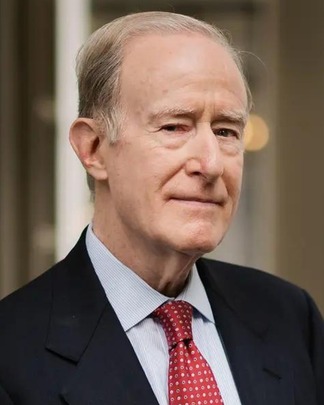
Benjamin Friedman
Benjamin Friedman is the William Joseph Maier Professor of Political Economy and former Chairman of the Department of Economics at Harvard University, where he has taught for nearly five decades. Widely recognized as one of the world’s leading macroeconomists, Friedman specializes in macroeconomic policy, monetary and fiscal analysis, and the societal and political challenges arising from automation, robotics, and artificial intelligence. Friedman has authored influential books, including The Moral Consequences of Economic Growth and Day of Reckoning, the latter of which received the George S. Eccles Prize. He has also written and co-edited more than a dozen academic books and authored over 100 articles on monetary economics, macroeconomics, and economic policy, providing key insights for economists, policymakers, and financial professionals. Prior to joining Harvard in 1972, Friedman gained experience in investment banking and economic consulting, working at Morgan Stanley & Co. in New York and collaborating with the Board of Governors of the Federal Reserve System, as well as the Federal Reserve Banks of New York and Boston. His work bridges rigorous economic theory with practical policy applications, making him a prominent voice in shaping modern economic thought.
Benjamin Friedman Professional Experience / Academic History
Professional Experience
-
William Joseph Maier Professor of Political Economy
-
Chairman, Department of Economics
-
Economist
-
Consultant to the President
-
Research Assistant
Academic History
-
Ph.D., Economics
-
M.Sc.,Economics and Politics
-
A.M., Economics
-
A.B., Economics, summa cum laude


CURRENT AFFILIATIONS
Trustee, Pioneer Funds
Director, Private Export Funding Corporation
Director, National Council on Economic Education
Member, The Brookings Institute's Panel on Economic Activity
Member, Encyclopedia Britannica Editorial Board
Contributor, The New York Reviews of Books
RESEARCH EXPERTISE
Widely recognized as one of the world’s leading macroeconomists, Benjamin Friedman specializes in macroeconomic policy, monetary and fiscal analysis, and the societal and political challenges arising from automation, robotics, and artificial intelligence.
His research focuses on macroeconomics, particularly the economics of monetary and fiscal policy, and the broader intersections between economics and society.
His work explores the effects of government budget deficits, the development of guidelines for U.S. monetary policy, and appropriate policy responses to crises in banking and financial systems.
PUBLICATIONS & AWARDS
Friedman is the author of Day of Reckoning, which won the George S. Eccles Prize for excellence in economic writing, and The Moral Consequences of Economic Growth, which examines the political and social implications of growth versus stagnation.
He has authored or edited nine additional books aimed primarily at economists and policymakers, along with more than 150 articles on monetary economics, macroeconomics, and fiscal policy published in leading journals.
His insights have also appeared in mainstream publications including The New York Times, The Wall Street Journal, and The New York Review of Books.
Over his distinguished career, Friedman has received numerous accolades, including the 2010 Phi Beta Kappa Prize, 2008 Medal of the Italian Senate, 2005 John R. Commons Award, 2003 Joseph R. Levenson Prize, 1982 David Horowitz Prize, and the 1966 John Henry Williams Prize.